← Borobudur Ticketsホームに戻る
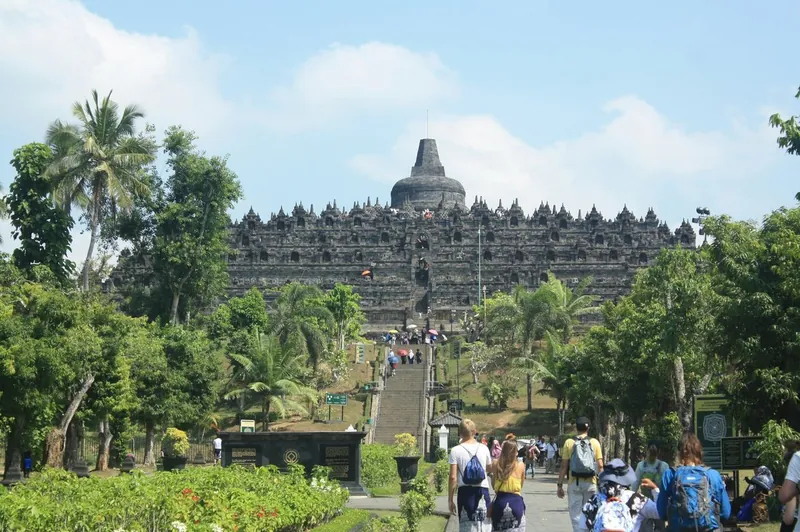
Borobudur Temple seen from the surrounding grounds with the Kedu Valley and volcanic hills behind 優先入場可

Borobudur's 1,200 Years: Burial, Rediscovery and Rescue

From the Sailendra builders to the ash that hid it, the 1814 clearance, the Dutch rebuild and the ten-year UNESCO campaign.

2026年8月 更新 · Borobudur Tickets コンシェルジュチーム

The Borobudur you climb today is not, in any simple sense, the monument the Sailendra builders left behind. It is the same stone, in very largely the same arrangement, but almost every block has been lifted, catalogued, cleaned and set back at least once — some of them twice within a single century. Between the ninth century and the twenty-first the building was completed, used, abandoned, buried, forgotten, cleared, looted, rebuilt, dismantled block by block, reassembled, inscribed as World Heritage, and buried again in ash within living memory. This guide follows that sequence, because standing on the terraces with it in mind is a very different experience from standing on them without.

The building: 8th and 9th centuries

Borobudur was raised in the 8th and 9th centuries during the reign of the Sailendra dynasty, in the Kedu Valley of southern Central Java. Construction is usually placed between roughly 780 and 840 CE — an enormous undertaking by any measure, using on the order of 56,600 cubic metres of grey volcanic stone, built around and over an existing hill rather than on level ground. The finished monument measures about 123 metres along each side of its base and rises some 35 metres above it.

It was never a temple in the sense of an enclosed sanctuary with a deity inside. It has no interior. What it has is a route: a stepped, unroofed pyramid of superimposing terraces crowned by a large bell-shaped dome, which UNESCO describes as a harmonious marriage of stupa, temple and mountain. The style shows the influence of Indian Gupta and post-Gupta art, and the plan combines the stupa, the temple mountain of Mount Meru, and the mandala — the square standing for earth, the circle for heaven.

Borobudur was also not built alone. The World Heritage property comprises three monuments: Borobudur itself and two smaller temples set to the east on a straight axis with it — Mendut, whose Buddha is a formidable monolith flanked by two bodhisattvas, and Pawon, a small temple whose interior gives no clue as to which figure was venerated there. The three are read together as phases in the attainment of nirvana, and the alignment is not coincidence. If your schedule allows, visiting all three in order is the closest a modern visitor comes to the intended approach.

Abandonment and burial

The monument served as a Buddhist temple from its construction until sometime between the 10th and 15th centuries, when it was abandoned. There is no single documented catastrophe to point at. The centre of Javanese political power shifted east, the region's religious life changed, and the great monument on the Kedu Plain gradually ceased to be maintained. In a landscape this volcanically active, ceasing maintenance is enough.

Volcanic ash did the rest. Borobudur sits within reach of Merapi, one of the most consistently active volcanoes on earth, and from around the year 1000 the monument was progressively buried under ash and then overgrown with vegetation. It did not vanish from local knowledge — villagers knew perfectly well that something large lay under the mound — but it disappeared from the wider world, and it stayed that way for centuries.

It is worth pausing on how long that is. The building spent roughly as long buried as it had stood in use. When it re-emerged, the dynasty that built it was five hundred years gone, the island's dominant religion had changed, and the language of the inscriptions on it was no longer read by anyone living nearby. Nothing about the monument's survival was inevitable.

1814: clearing the mound

The monument returned to public view in 1814, during the brief British administration of Java, when the lieutenant governor Thomas Stamford Raffles was told of a large ruin in the jungle near the village of Bumisegoro. Raffles did not do the work himself. He sent the Dutch engineer Hermann Cornelius, who with some 200 men spent two months cutting down trees, burning off vegetation and digging away the earth until the shape of the terraces emerged.

That clearance is conventionally called a rediscovery, and the word deserves a little scepticism. The people living around the mound had not misplaced it. What 1814 did was bring the monument into European scholarly and administrative attention — with everything that followed from that, good and bad. The nineteenth century treated Borobudur as a quarry of curiosities as much as a monument: statues left the site, heads left statues, and souvenirs left with visitors of consequence.

The century after the clearance was, on balance, harder on the building than the centuries of burial had been. Exposed again to monsoon rain, with its drainage no longer functioning as designed and its foundations bearing weight they had settled around, the structure began to deform. By the early 1900s the terraces were visibly out of true and the reliefs were eroding. Intervention was no longer optional.

Two restorations, one century

The first campaign ran from 1907 to 1911 under Dutch archaeologists, and it was a rescue rather than a reconstruction: stabilising what was collapsing, resetting what had shifted, addressing the drainage. It bought the monument several decades. It did not solve the underlying problem, which was that water was still moving through the fill inside the terraces and carrying the hill with it.

The second campaign was on a completely different scale. Undertaken with UNESCO's help and international funding, the main work ran through the second half of the 1970s and into the early 1980s, and the restoration was completed by 1983. Over a million stones were dismantled and removed, the reliefs cleaned and treated, a new drainage system installed inside the structure, and the whole then reassembled by anastylosis — putting the original blocks back in their original positions, with as little new material as possible.

Anastylosis is a slow, unglamorous, deeply conservative method, and it is why Borobudur reads as authentic rather than as a replica. New andesite was used only where a block was missing or too far gone to bear load. Everything else that stands on the terraces today is the stone the Sailendra masons cut. When you are told that a thousand-year-old surface should not be touched, this is the context: the surface survived burial, clearance and two dismantlings, and it is not indestructible.

UNESCO inscribed the Borobudur Temple Compounds on the World Heritage List in 1991, under criteria recognising it as a masterpiece of Buddhist architecture and monumental art, as an outstanding example of Indonesian art and architecture from the early 8th to the late 9th centuries, and for its association with living Buddhist tradition.

2010, and why the rules are what they are

In October and November 2010 Merapi erupted again, and the monument was reminded of the process that had buried it a thousand years earlier. Ash fell on the temple to a depth of up to about 2.5 centimetres, coating the statues, filling the carving and clogging the drainage system that the previous restoration had installed. The clean-up was a major undertaking, supported by a UNESCO contribution of some three million US dollars, and the acidic ash had to be removed from the stone before it could do lasting damage.

That event is the direct ancestor of the rules visitors meet today. The special footwear issued for climbing the structure, the capped and timed sessions, the guide who walks with every group, the prohibitions on touching the reliefs and on carrying food or drink up the terraces — none of these are ceremonial. They exist because a monument that has been buried, cleared, rebuilt twice and ashed again within living memory is a fragile object with three million visitors a year walking on it.

We mention this not to lecture but because it genuinely improves the visit. Rules that feel arbitrary at the gate stop feeling arbitrary once you know that a million stones were taken down and put back by hand within the lifetime of people still working at the site. The restraint asked of you is small, and it is the reason the terraces are open at all.

A living monument, not a ruin

It is easy to file Borobudur under archaeology and leave it there. That would be a mistake. Since its clearance and restoration it has been brought back into use as a Buddhist site, and once a year, at the full moon of May or June, Indonesian Buddhists observe Vesak with a procession that begins at Mendut and ends here, walking clockwise around the monument in the same direction the reliefs are meant to be read. Saffron robes on those terraces are not a re-enactment.

Alongside that, the site now carries more than three million visitors a year, which makes it one of the most heavily used monuments in Southeast Asia and explains a good deal about how it is run. Access to the structure itself is rationed through limited timed sessions with a guide, the grounds absorb the bulk of the footfall, and the two museums inside the park take pressure off the terraces while giving visitors something the terraces cannot.

If you visit around Vesak, expect the site to be busier and parts of it to be given over to observance; that is the trade for seeing the monument doing what it was built for. At any other time of year, the thing worth carrying up the stairs is simply the awareness that this is a functioning religious place with a twelve-century history of interruption, and that you are one of three million people asked to tread lightly on it this year.

よくある質問

Was Borobudur really lost for centuries?

It was abandoned sometime between the 10th and 15th centuries and progressively buried under volcanic ash from around the year 1000, then overgrown. Local communities knew a large structure lay beneath the mound; what changed in 1814 was that it entered wider scholarly and administrative attention, after Thomas Stamford Raffles sent the engineer Hermann Cornelius and around 200 men to clear it.

How many times has Borobudur been restored?

Twice at scale in the twentieth century. A Dutch-led campaign ran from 1907 to 1911, stabilising a structure that was visibly deforming. A far larger international campaign backed by UNESCO ran through the later 1970s and was completed by 1983, dismantling over a million stones, installing new internal drainage and reassembling the monument by anastylosis using the original blocks.

How much of the temple is original stone?

The great majority. The 1970s campaign used anastylosis, which means original blocks were returned to their original positions and new andesite was introduced only where stone was missing or structurally spent. That is precisely why conservation rules on the terraces are strict: what you are walking past is ninth-century carving, not a modern reproduction of it.

Did the 2010 Merapi eruption damage the temple?

It coated it. Ash up to about 2.5 centimetres thick fell across the statues and reliefs and blocked the drainage system installed during the previous restoration. The clean-up was extensive and drew a UNESCO contribution of around three million US dollars. The monument came through it, but the episode is a live demonstration of why the site is managed as carefully as it is.

Are Mendut and Pawon worth visiting too?

If you have the time, yes. The World Heritage property is three monuments, not one: Borobudur plus Mendut and Pawon, set to the east on a straight axis with it and understood as phases in the attainment of nirvana. Mendut holds a monumental seated Buddha flanked by two bodhisattvas. Both are small, quiet and a short drive away, and they make far more sense of Borobudur than a second climb would.

When was Borobudur made a World Heritage Site?

In 1991, when UNESCO inscribed the Borobudur Temple Compounds — Borobudur, Mendut and Pawon together. The listing recognises the monument as a masterpiece of Buddhist architecture and monumental art, as an outstanding example of Indonesian art and architecture between the early 8th and late 9th centuries, and for its enduring association with living Buddhist practice.