Comparison
Borobudur vs Prambanan
Which should you visit?
At a glance
If you have time for both, do both — they are 90 minutes apart, both UNESCO World Heritage Sites, and the contrast is half the point (Borobudur is Buddhist, Prambanan is Hindu). If you can only pick one, pick Borobudur for most visitors: more globally famous, more emotionally moving, and the sunrise experience is unique. Pick Prambanan if you want Hindu architecture, the Ramayana reliefs, or the evening Ramayana Ballet. The combo day tour visits both in around 10 hours for €129 per person, which is the simplest way to see them together.
Most travellers planning a visit to Yogyakarta ask the same question eventually: is it worth seeing Prambanan as well as Borobudur, and if you only have time for one, which should it be? The answer is nuanced — they are different religions, different styles, different moods, and they reward different things. Here is the honest comparison.
Quick answer
If you have time for both, do both. They are 90 minutes apart by car, both are UNESCO World Heritage Sites, and the contrast between them is half the point — Borobudur is Buddhist, Prambanan is Hindu, and visiting both in a single trip tells a far more complete story about Central Java in the 9th century than either does alone.
If you can only pick one: Borobudur, for most visitors. It is the more globally famous of the two, more emotionally moving, and the sunrise experience is unique in the region. Pick Prambanan if you are specifically into Hindu architecture or the Ramayana epic, or if you want the Ramayana Ballet (which is performed nightly at Prambanan).
The comparison at a glance
| Borobudur | Prambanan | |
|---|---|---|
| Religion | Buddhist | Hindu |
| Built | ~800–850 CE | ~850 CE |
| Scale | Single monument, 9 terraces, 72 stupas, 2,672 relief panels | Compound of 240+ temples; main trio are 47 m tall |
| Shape | Stepped pyramid / mandala | Tall pointed spires (candi) |
| Location | 40 km NW of Yogyakarta, rural Central Java | 17 km east of Yogyakarta, near the airport road |
| Ticket price | €49–89 depending on session | €49 |
| Best for | Atmosphere, contemplation, sunrise | Architectural drama, daytime exploration, ballet evenings |
| UNESCO | World Heritage since 1991 | World Heritage since 1991 |
| Opening hours | Sessions 08:30–15:30 + sunrise/sunset | Daily 06:30–17:00 |
| Visit time needed | 2–3 hours for daytime session; longer for sunrise or pack | 2–3 hours for a relaxed visit |
The case for Borobudur
Borobudur is the world's largest Buddhist monument and arguably the most visually coherent ancient structure in Southeast Asia. It is built as a single mandala — a three-dimensional map of the Buddhist cosmos — with five square terraces carved with the life of the Buddha, three circular terraces topped with 72 latticed stupas containing hidden Buddha statues, and a single main stupa at the summit. You climb through the levels the same way a 9th-century pilgrim would have, encountering the reliefs in the intended narrative order.
What sets Borobudur apart from Prambanan and from most other temples in Asia:
- The sunrise experience. Borobudur is one of the few major temples in the world where you can be on the monument at dawn, before the public opening, with fewer than 100 other people. There is no equivalent experience at Prambanan.
- The 2,672 relief panels. The narrative panels carved into the square terraces tell the full life of the Buddha across roughly 1,300 scenes, plus a second level of moral parables (the Karmawibhangga, most of which is hidden in the base) and the journey of a pilgrim named Sudhana through the Gandavyuha Sutra. It is the single most comprehensive Buddhist narrative art programme ever made.
- The emotional tone. Borobudur feels contemplative. The terraces spiral inwards and upwards, you climb in silence with a guide, and the effect is closer to a meditation than a sightseeing stop.
- The setting. Rural Central Java, rice paddies on all sides, two volcanoes (Merapi and Merbabu) visible from the upper terraces on a clear day. Prambanan is near a highway; Borobudur is out in the landscape.
The case against Borobudur is that it is further from Yogyakarta (90 minutes vs 30), which matters if you are tight on time. It is also more regulated — the Visitor Flow Management System means you are climbing with a licensed guide and a fixed group, whereas at Prambanan you can explore more freely.
The case for Prambanan
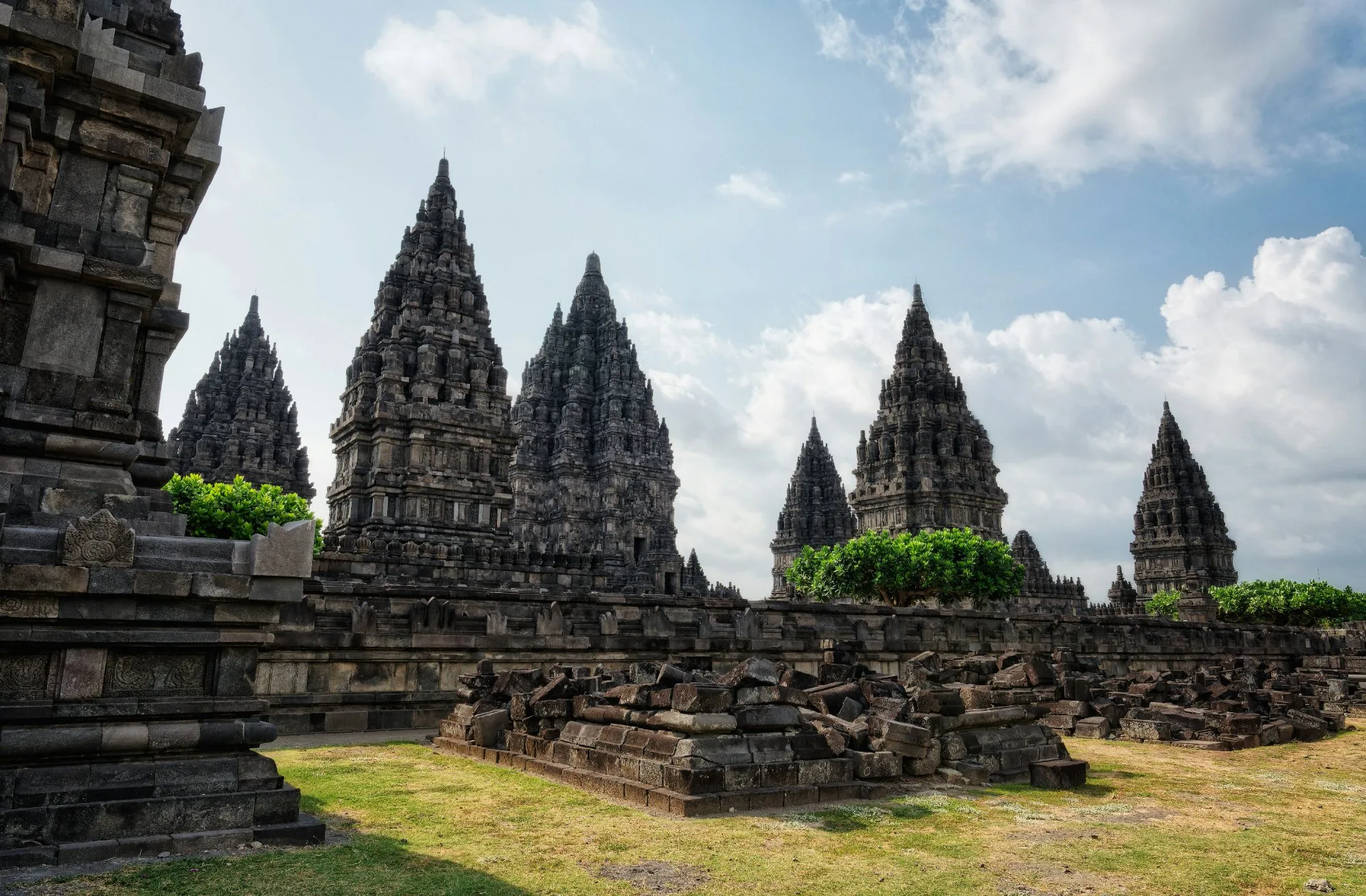
Prambanan is the largest Hindu temple complex in Indonesia, and visually it is unlike anything else in the region. Instead of Borobudur's single mandala, Prambanan is a compound of 240-plus individual temples (candi), dominated by three soaring 47-metre towers dedicated to Shiva, Vishnu, and Brahma — the Hindu trimurti. The tallest is the Shiva temple in the centre; inside its inner walls are the oldest surviving stone carvings of the full Ramayana epic.
What makes Prambanan worth a specific trip:
- The verticality. Borobudur is a climb across a broad, low, stepped pyramid. Prambanan is spires — narrow, sharp, reaching upwards in a way that feels closer to European gothic cathedrals than to Buddhist mandalas. The architectural language is completely different.
- The Ramayana reliefs. Inside the Shiva temple, the 9th-century reliefs of the Ramayana are among the oldest surviving depictions of the epic anywhere. Reading them is a direct connection to one of humanity's foundational stories.
- The Ramayana Ballet. Three evenings a week (Tuesday, Thursday, Saturday), 200 dancers and a full gamelan orchestra perform the Ramayana on an open-air stage with the illuminated Prambanan towers as the backdrop. It is one of the most spectacular cultural performances in Indonesia. Borobudur has no equivalent.
- Ease of access. Prambanan is 30 minutes from Yogyakarta by car, and 20 minutes from the airport. If you are short on time, Prambanan is the easier visit.
- The outer temples. Most visitors only see the main trimurti compound, but the Prambanan archaeological park contains several other significant temples — Sewu, Lumbung, and Bubrah — reachable by a free shuttle from the main entrance. These add up to a much richer visit than most guidebooks acknowledge.
The case against Prambanan on its own is that the experience is more conventional — you are walking around a complex in full daylight with a guidebook, not climbing through a mandala at dawn. It is spectacular, but it is not unique in the way Borobudur is.
The religious context — why this matters
Borobudur and Prambanan were built within fifty years of each other in the same region of Central Java, by different dynasties, representing the two great religious traditions that coexisted in Java in the 9th century. Borobudur is a Sailendra-dynasty Buddhist monument; Prambanan is a Sanjaya-dynasty Hindu temple complex.
Visiting both together gives you the full story: how Buddhist and Hindu architecture and worldview looked side-by-side in medieval Java, how the two traditions borrowed from and contrasted with each other, and how Indonesia became the world's largest Muslim country afterwards while preserving this non-Muslim heritage as national treasures. You cannot really understand 9th-century Central Java from either temple alone.
The practical upshot: do not treat this as a simple "which is better" comparison. They are complementary, not competing.
Doing both — the combo day tour
The cleanest way to visit both in one day is our combo day tour: private driver, air-conditioned vehicle, Borobudur in the morning (typically 08:30 or 09:30 session), lunch at a local restaurant between the two, Prambanan in the afternoon. The tour runs approximately 10 hours door to door from Yogyakarta, and costs €129 per person.
The benefit of doing both in one day rather than splitting across two days:
- One transport booking, not two. Two round-trip transfers would cost more than the combo.
- Natural pacing. Borobudur in the cool morning light, Prambanan in the warm late-afternoon light. Both at their best.
- The ballet add-on. On Tuesday, Thursday, and Saturday evenings, you can add the Ramayana Ballet to the same day — the driver drops you at the open-air theatre after the Prambanan visit and collects you after the show. The most complete Borobudur + Prambanan day possible.
The downside: it is a long day. If you are travelling for several weeks and Borobudur is the main focus of your Yogyakarta stop, you may prefer to do sunrise at Borobudur on Day 1 and a relaxed Prambanan visit on Day 2 with the ballet in the evening. That splits the experience at a more civilised pace.
Book the combo tour, or build your own
Private driver, both UNESCO sites, around 10 hours door to door. Or mix and match the individual tickets and transfers to suit your pace.
Combo day tour Prambanan only Ramayana BalletIf you only have one day — which do you pick?
If circumstances force a choice:
- Pick Borobudur if: this is your first visit to Indonesia, you want the unique sunrise or sunset experience, you are interested in Buddhism or meditation, you want the bucket-list recognition of seeing the world's largest Buddhist monument, or you are a photographer drawn to the atmospheric shots.
- Pick Prambanan if: you are specifically interested in Hindu architecture or the Ramayana epic, you want to pair the daytime visit with the Ramayana Ballet in the evening, you are very short on time (Prambanan is closer to Yogyakarta and needs less of a day to visit well), or you are doing a broader trip through Hindu sites in Asia and want the Indonesian example.
- Pick the combo tour if: this is the only day you have in Yogyakarta and you want to see both without the logistics headache.
Things nobody tells you
Borobudur is bigger than it looks in photographs
The 3D scale of Borobudur — 118 metres wide at the base, 35 metres tall at the central stupa — does not come through in most photographs. Walking around the base takes 10 minutes. Climbing through all nine terraces takes 45 minutes of steady walking. Plan more time than the photos suggest.
Prambanan is bigger than it looks on a map
Most visitors plan for 1–2 hours at Prambanan based on the size of the main trimurti on the map, then discover that the surrounding compound has another 200+ smaller temples, outlying candi reachable by a free shuttle, and a large archaeological museum. Allow 2–3 hours to do it justice.
The 90-minute transfer between the two can include other stops
The drive from Borobudur to Prambanan passes through the outskirts of Yogyakarta. If you are doing both in a day with a private driver, ask about adding a stop at the Kraton (the Yogyakarta sultan's palace), Taman Sari (the former water castle), or a local batik workshop — any of these can be inserted into the middle of the day without a significant schedule hit.
The Ramayana Ballet is the best cultural experience in Central Java
This is a strong claim but we stand by it. 200 dancers, a full gamelan orchestra, two hours, the illuminated Prambanan towers as the backdrop, and the 2,000-year-old Ramayana epic told entirely through dance and music. It runs three evenings a week and almost nobody who sees it regrets it. If you are in Yogyakarta on a Tuesday, Thursday, or Saturday, book the ballet.
Borobudur feels sacred; Prambanan feels royal
A subjective observation but one many visitors report independently. Borobudur has the emotional tone of a meditation retreat — quiet, inward, cumulative. Prambanan has the tone of a royal court — imposing, outward, impressive. Both are extraordinary but they do different work on you.