← 返回Borobudur Tickets首页
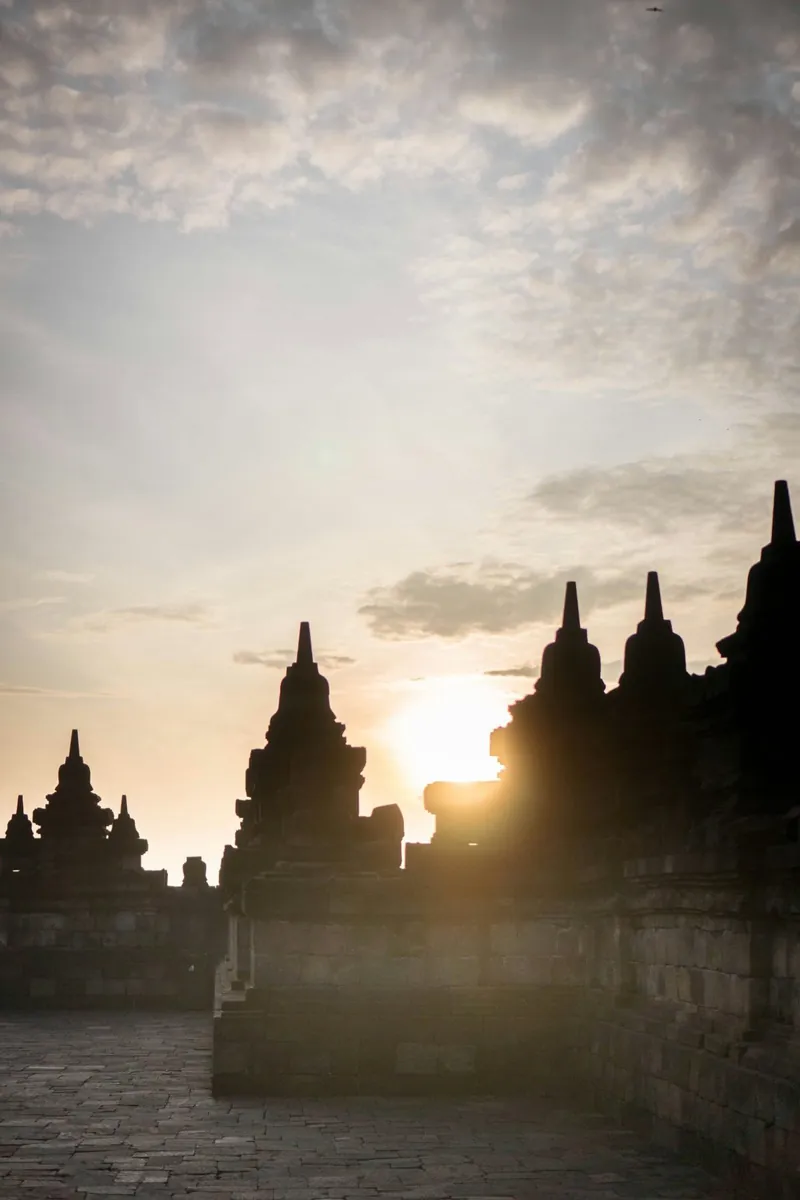
Visitors on the upper circular terraces of Borobudur among the perforated bell-shaped stupas at first light 支持免排队

Climbing Borobudur: Sessions, Sandals and Etiquette

How access to the terraces actually works, what the sandals are for, when the grounds are the better choice, and how to handle heat and rain.

更新于 2026年8月 · Borobudur Tickets 礼宾团队

Climbing Borobudur is no longer a matter of turning up and walking upstairs. Access to the monument itself is rationed: a fixed number of ninety-minute sessions each day, a licensed guide with every group, special footwear issued at the gate, and a set of rules on the terraces that are enforced rather than suggested. None of this is difficult, but it does reward knowing in advance, because the visitor who arrives understanding how the system works spends their session looking at the building instead of working out the procedure. This guide covers the mechanics of the timed ascent, the etiquette that goes with it, how to decide between the terraces and the grounds, and what tropical heat and afternoon rain actually do to the experience.

How access to the structure works

The site's operating day runs from 08:00 to 16:00 WIB, and it now opens every day of the week, including Mondays — a change from the older schedule that still catches returning visitors out. Access to climb the monument is divided into eight ninety-minute sessions spread between 08:30 and 15:30. You choose your session when you book, and the ticket is tied to that time rather than to the day in general. Golden-hour access sits outside this pattern: sunrise entry starts from 04:30, and sunset access falls in the late afternoon.

Each session is capacity-managed rather than open-ended, which is the whole point of the system. The number of people permitted onto the terraces at any one time is controlled, so the galleries stay walkable and the stone carries a fraction of the load three million annual visitors would otherwise put on it. In practice this means the terraces feel far less crowded than the ground-level crowds would lead you to expect — but it also means popular sessions genuinely run out, and the fix is booking earlier rather than arriving hopeful.

Every group that climbs is accompanied by a licensed Pamong Carita guide. This is not an upsell you can decline; it is how the ascent is structured. The guides are locally trained interpreters of the monument, and the quality of your ninety minutes depends more on how you use them than on anything else. Tell your guide at the start what you actually want — the reliefs, the architecture, the Buddhist reading of the terraces, the restoration history — and the session reshapes around it.

Check-in happens before your session begins, not at its start time. Allow half an hour: the meeting point is confirmed on your booking and is not always the main gate, the footwear counter takes a few minutes, and car parking moved to a new area north-west of the complex in 2025, which added a walk to the front of everyone's day.

Upanat sandals and what you can carry up

Everyone climbing the structure wears Upanat — woven sandals with a soft sole, issued by size at the counter after check-in and worn in place of your own shoes on the monument. They exist for one reason: conventional footwear abrades ninth-century andesite, and with the volume of visitors this site receives, the wear is measurable. The sandals are provided as part of the climb; you do not need to source your own. If you are prone to blisters between the toes, a pair of thin toe socks in your bag solves the only complaint anyone makes about them.

What you cannot take up is more restrictive than most visitors expect. No food or drink on the structure, water included — so drink properly before you check in rather than planning to sip your way up. No drones anywhere on the site. No pets, no sharp objects, no tripods or large telephoto lenses without prior authorisation. Personal photography, on the other hand, is welcome throughout, on the grounds and on the terraces alike, so a phone or a normal camera is entirely fine.

Dress is modest: shoulders and knees covered, as at any active religious site in Indonesia. Sarongs are available at the entrance if you have misjudged it. Beyond that, dress for the climate rather than the dress code — light breathable fabric, a sunhat, sunscreen, and for a sunrise session a warm layer, because the terraces before dawn are genuinely cool and the wait is longer than people imagine.

Terraces or grounds: how to decide

Not everyone should climb, and the site is designed on that assumption. Grounds admission gives you the archaeological park, the full circuit of the monument at base level, the exposed south-east corner of the hidden foot, and both museums — the Karmawibhangga, which holds the documentation of the buried base panels, and the Samudraraksa, built around the ships carved into the monument's walls. That is a substantial half-day in its own right and it requires no stairs at all.

Climb if you want the galleries and the upper terraces: the narrative reliefs read at walking pace, the perforated stupas at close quarters, the view over the Kedu Valley. Stay on the grounds if stairs are a problem, if you are travelling with a toddler, if the heat is punishing that day, or if you simply want the monument as an object rather than as a route. Neither is a consolation prize — a slow grounds visit with the museums is a better use of three hours than a hurried climb.

You can also do both, and many visitors should. The grounds are open across the full operating day, so a mid-morning session on the terraces followed by the museums in the early afternoon uses the site properly. If you have booked a golden-hour experience, the climb is already included in it — sunrise, sunset and the combined pack all take you up the terraces, so a separate structure session is only worth adding if you specifically want the monument in daylight as well.

Etiquette on the terraces

Borobudur is an active place of Buddhist worship as well as a World Heritage monument. Indonesian Buddhists observe Vesak here each year at the full moon of May or June, ending a procession from Mendut with a clockwise circumambulation of the monument. Walking clockwise yourself is not required of visitors, but it is how the building is meant to be read and it costs you nothing to follow.

Do not touch the reliefs. Do not lean on them, rest a bag against them or run a hand along them while walking; hand oils and abrasion are precisely what the surviving carving cannot absorb at scale. Do not climb on the walls or the balustrades. And do not reach into the openwork stupas to touch the Buddha inside, however many people you see doing it — the tradition is widespread, it damages both statue and stupa, and it is disrespectful of a figure that is an object of veneration rather than a lucky charm.

The upper limit of visitor access is the ninth terrace; the summit stupa itself is not open. Keep your voice down in the galleries, which are narrow and carry sound, and let people ahead of you finish looking before you move into their space. Small courtesies matter here more than at most monuments, because everyone on the terraces is on the same ninety-minute clock as you are.

Heat, rain and the shape of the day

Central Java is tropical lowland, and the temple is unshaded stone. The terraces heat up quickly once the sun is properly over the valley, and the stone radiates it back at you. This single fact should drive your session choice more than anything else: an early-morning slot is materially more comfortable than a midday one, and the difference between 08:30 and 12:30 in March is not marginal. If you are visiting with children or anyone who struggles in heat, book the earliest session you can get.

The wet season brings a different rhythm. Rain here tends to arrive as heavy afternoon storms rather than all-day drizzle, which makes a morning session the sensible default again, and it makes the grounds and museums a genuinely useful fallback for the hours after. Carry a light rain shell rather than an umbrella — you will be on open terraces where an umbrella is awkward and, in wind, a hazard to the people beside you.

The compensations of wet-season visiting are real: the valley is green, the light is dramatic, the crowds thin, and the volcanic hills that ring the plain are visible between the storms in a way they often are not in the dusty months. A cloudy sunrise is a genuine risk in that season, but a sunrise session is not wasted when the clouds win — the terraces at dawn without crowds are worth the alarm on their own terms.

Whatever the season, budget more time than the session length suggests. Ninety minutes on the structure plus two to three hours for the grounds and museums is a realistic full visit, and rushing the second half to make a driver's schedule is the most common way people short-change themselves here.

Accessibility, mobility and children

The main grounds are flat and accessible, as are both museums, and the archaeological park around the monument can be enjoyed at length without stairs. The structure cannot. Climbing it means multiple steep, narrow stone staircases with high risers, worn treads and no handrails of the kind a modern building would require. It is not wheelchair accessible and it is not realistically manageable for anyone with significant mobility limitations, a knee or hip problem, or a fear of steep descents.

Descending is the part people underestimate. The stairs are steeper going down than they feel going up, the sandals have a soft sole, and there is no shortcut once you are at the top. If you have any doubt about the descent, the honest answer is to enjoy the monument from the grounds — the view of the terraces from below is magnificent and the museums are where the hidden panels live.

Children under three enter free, and the site is more child-friendly than the stair-count suggests: the grounds are open and green, the Jataka relief panels in the first gallery are full of animals, and the museums break up the day. Under-tens do receive a reduced rate on structure access, which we arrange by email rather than through the standard booking flow. For a family visit, an early session and a long, unhurried grounds afternoon works far better than trying to see everything from the terraces.

常见问题

How long is a Borobudur temple structure session?

Ninety minutes on the monument itself. There are eight such sessions daily, spread between 08:30 and 15:30, and your ticket is tied to the session time you choose at booking. Allow roughly half an hour beforehand for check-in and footwear, and a further two to three hours afterwards if you want to do the grounds and the two museums properly.

Do I have to wear the Upanat sandals?

Yes, for anyone climbing the structure. They are issued by size at the counter after you check in, and they replace your own shoes on the monument. The soft sole is there to protect ninth-century stone from abrasion. Bring thin toe socks if you are prone to blisters; nothing else is needed, and you do not have to supply your own footwear.

Can I bring water up to the terraces?

No. Food and drink are not permitted on the structure, water included, so hydrate before you check in and again when you come down. It sounds harsh in the tropics, but the sessions are ninety minutes rather than a full day, and an early-morning slot makes the restriction easy to live with. The grounds have no such limitation.

Is Borobudur wheelchair accessible?

The grounds are — flat, open and easily covered, with both the Karmawibhangga and Samudraraksa museums accessible and included with grounds admission. The monument itself is not: climbing it means several steep, narrow stone staircases with worn treads and no modern handrails, and the descent is harder than the ascent. Visitors with mobility limitations get far more from a grounds visit.

Which session time should I choose?

The earliest you can get, in most cases. The terraces are unshaded and the stone holds heat, so a morning session is materially more comfortable than a midday one, and in the wet season it also sits ahead of the afternoon storms. Later sessions have their own advantage — softer light and thinner crowds — but they are a harder proposition with children or in the hot months.

Do I need a separate structure ticket if I have booked sunrise or sunset?

No. The golden-hour experiences already include the full climb of every terrace up to the ninth level — the same physical access as a daytime structure session, in better light. Add a daytime session only if you specifically want to see the monument in daylight as well, or if the golden-hour sessions you wanted are already taken and you want a midday alternative.